
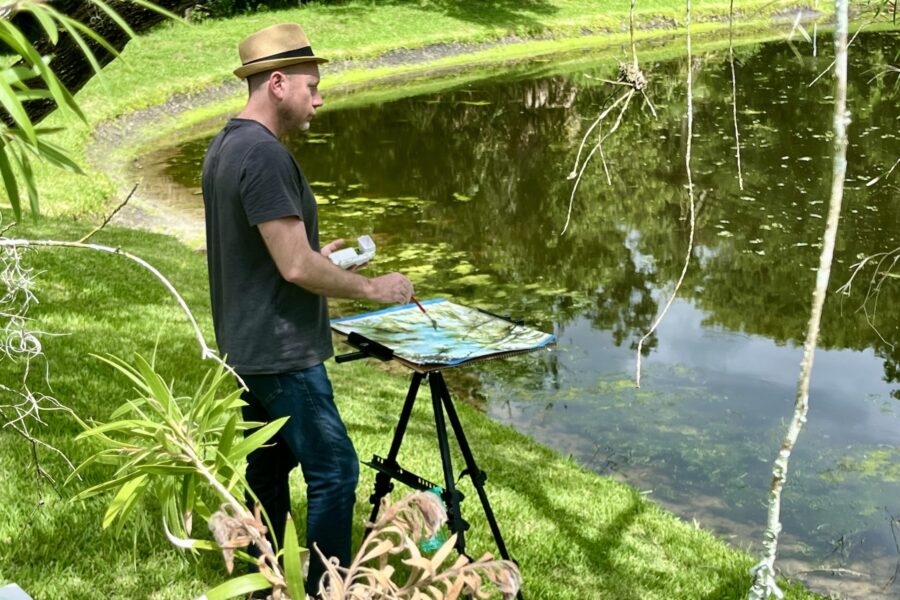
At some point in their career, many professional artists set aside time to participate in an art residency or retreat in order to shake up their established rhythms and hone in on new sources of inspiration. These residency experiences often involve traveling somewhere other than their normal studio space, which allows artists to focus their attention on a unique style of work or create a site-specific project.
Jon Seals ’03, chair of the Department of Art and Digital Media at Olivet Nazarene University, has participated in multiple residencies over the past two decades, in addition to exhibiting solo show collections and being selected for juried group shows. While Seals takes pride in the fact that his full-time job as a professor at Olivet centers his daily work on training future generations of talented artists, he finds immense value in similarly investing in his craft.
“I’m compelled to grow in my art practice” he says of his drive to devote time to his own artistic process by participating in periodic residencies. “There’s always more to discover in the materials and in the landscape, and that curiosity becomes a bridge to people, a way of creating wonder and connection together.”
In the spring, Seals applied to Kress Contemporary in Ybor City, Florida, for a two-week residency in which he would uniquely exhibit some completed artworks while simultaneously creating new pieces. For this Brackish Waters collection, which is an expansion of a series he has worked on since 2015, the watercolor works were a combination of long panels of watercolor paper — hung from the ceiling or draped over irrigation tubes mounted to the wall with flanges — and large circular compositions. All of the pieces were painted using collected brackish water, a natural phenomenon in which fresh and salt waters converge. 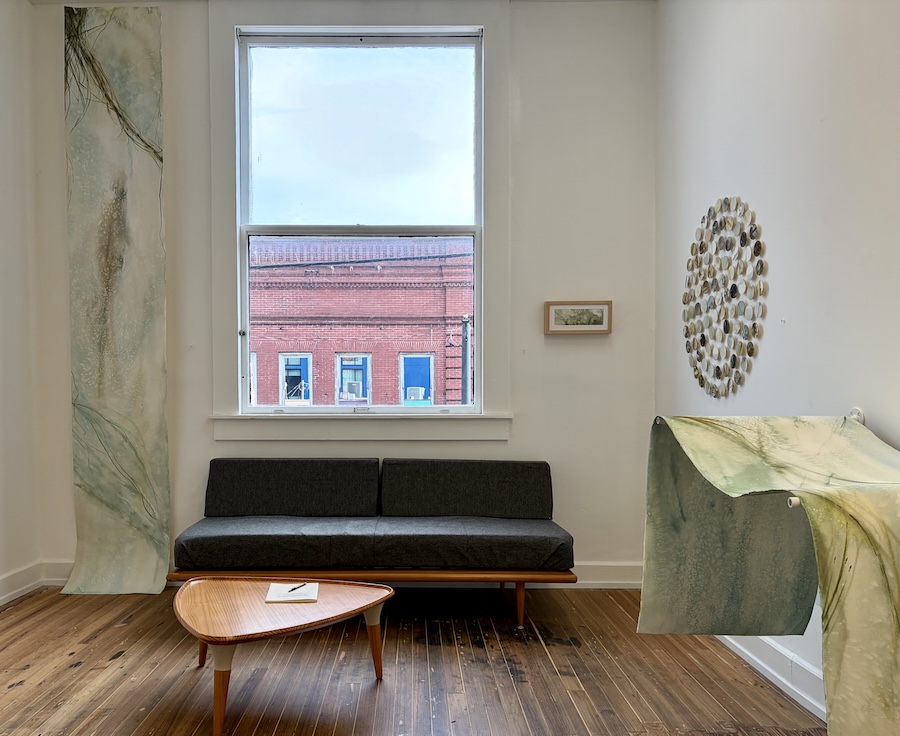
During his master’s program at Yale Divinity School, which combined art and religion, Seals first considered how the materials artists use, not just the topical nature of their art, can communicate ideas to the viewer.
“I began to see the material as not just being the resource for doing what I wanted to do, but that the material has its own story and carries weight. I thought more and more about the history of how my tools have been used. When I started working with water from the Bay or the Kankakee River, I wanted my art to honor the history of that water, of that place.”
Seals had been using brackish water as his water source for his paintings for many years. After some trial and moldy-painting-errors, which were the result of painting directly with the collected water, he knew that boiling was an essential part of producing archival-grade work suitable for exhibiting and selling. So, for plein air (outdoor) painting, he collects water, boils it to process out live organisms and then returns to the site of collection to paint his unique landscapes which depict, or at least emulate, natural elements.
This ongoing series of work has opened doors for Seals to travel and engage with various communities through exhibitions and artist talks. However, what set this residency apart from his past experiences of creating as a solo artist, was the very intentional format of inviting other people into a collective process of creating art together.
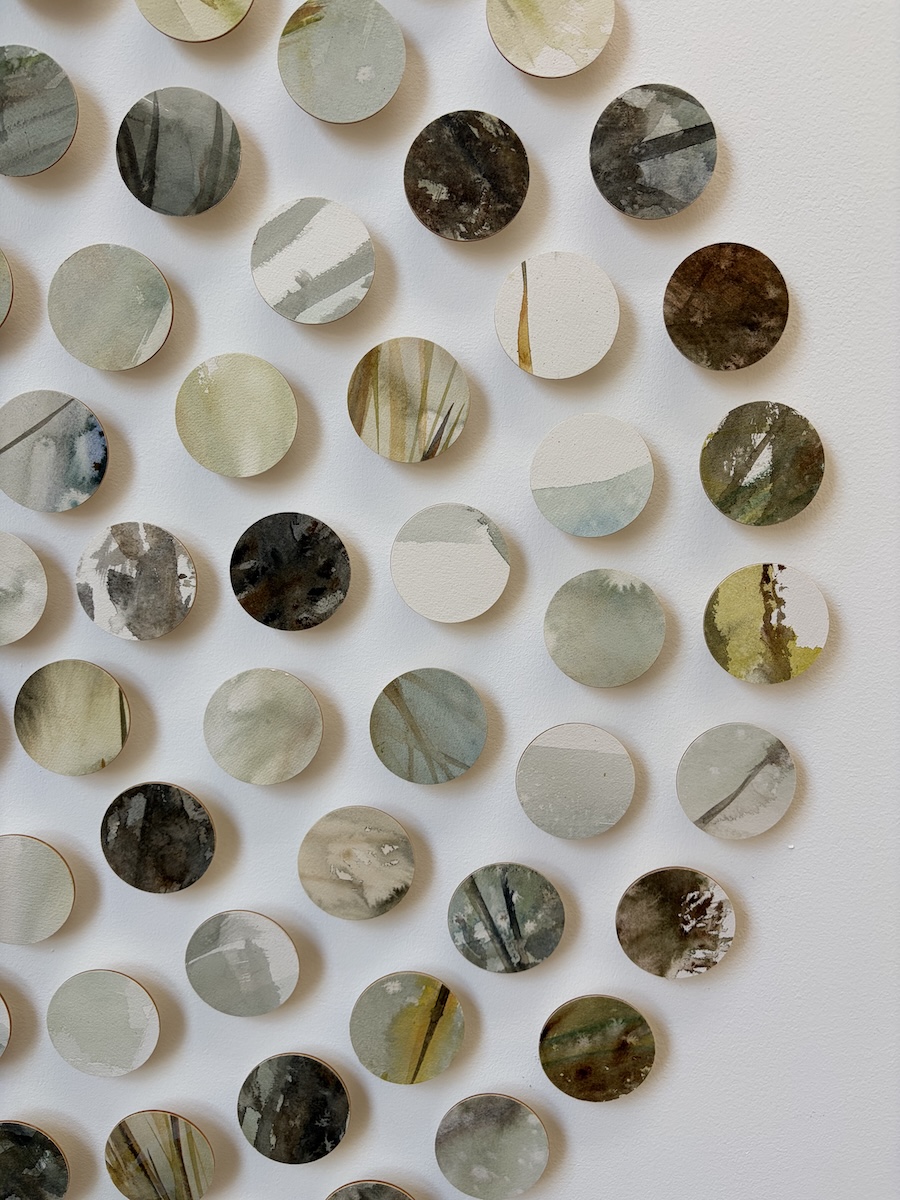 Based on a project that he piloted with Olivet students in a watercolor painting class this past spring, the idea behind the community element of his residency exhibition was to have people create a watercolor painting out of which he asked them to cut a 2.5-inch circle. Those flat round shapes were then mounted on a thin piece of wood attached to a push pin. Seals then curated a selection of the circles into two 94-piece circular roundel artworks which corresponded with a similar mosaic he created.
In preparation for exhibiting completed art as well as hosting the workshops, Seals spent the early summer months meticulously planning his materials, installation techniques and workshop details.
“Because I was trying new things, I needed to figure out what would work best before bringing the project into a public setting. A singer wouldn’t give a performance without rehearsing, even if they already knew the song. This was my version of rehearsal. For instance, I knew I wanted to suspend paper from the wall, but it had to be installed securely, safely, and in a way that was both archival and meaningful. I tried at least five different methods before landing on the perfect solution. Preparing for all of that took more time than most people would probably imagine.”
Although there is an undercurrent of joyful spontaneity in painting outdoors, Seals also recognized the importance of approaching the residency with a level of seriousness and respect for the work itself and for the community into which he was bringing his art.
“I knew that in that art community, the work I produced had to be excellent, it wouldn’t be accepted otherwise. There’s comfort in knowing there is a lineage of other artists in the area and that I was stepping into an ongoing story. This residency gave me the chance, and encouragement, to try new things. Kress Contemporary is a building filled with amazing artists doing such important work, performance art, visual art, film, and other expressions. It was exciting to be part of that community for two weeks.”
During his time at the residency in Florida, Seals hosted free art workshops staged along the Bay for anyone who was interested. He provided all of the supplies necessary to make the activity as approachable as possible for the community. His goal was two-fold: encourage people to connect through art and to bring some awareness to clean water issues in the area.
“The more I kept talking and thinking about community, the more I was aware that I wasn’t really out in the community,” Seals said of his motivation for the collaborative nature of this project. “Right now, everyone is so divided — politically, socially, geographically. Tampa Bay is filled with fresh and salt water and that coming together of different kinds of water inspired me to want to bring people of different points of view together.”
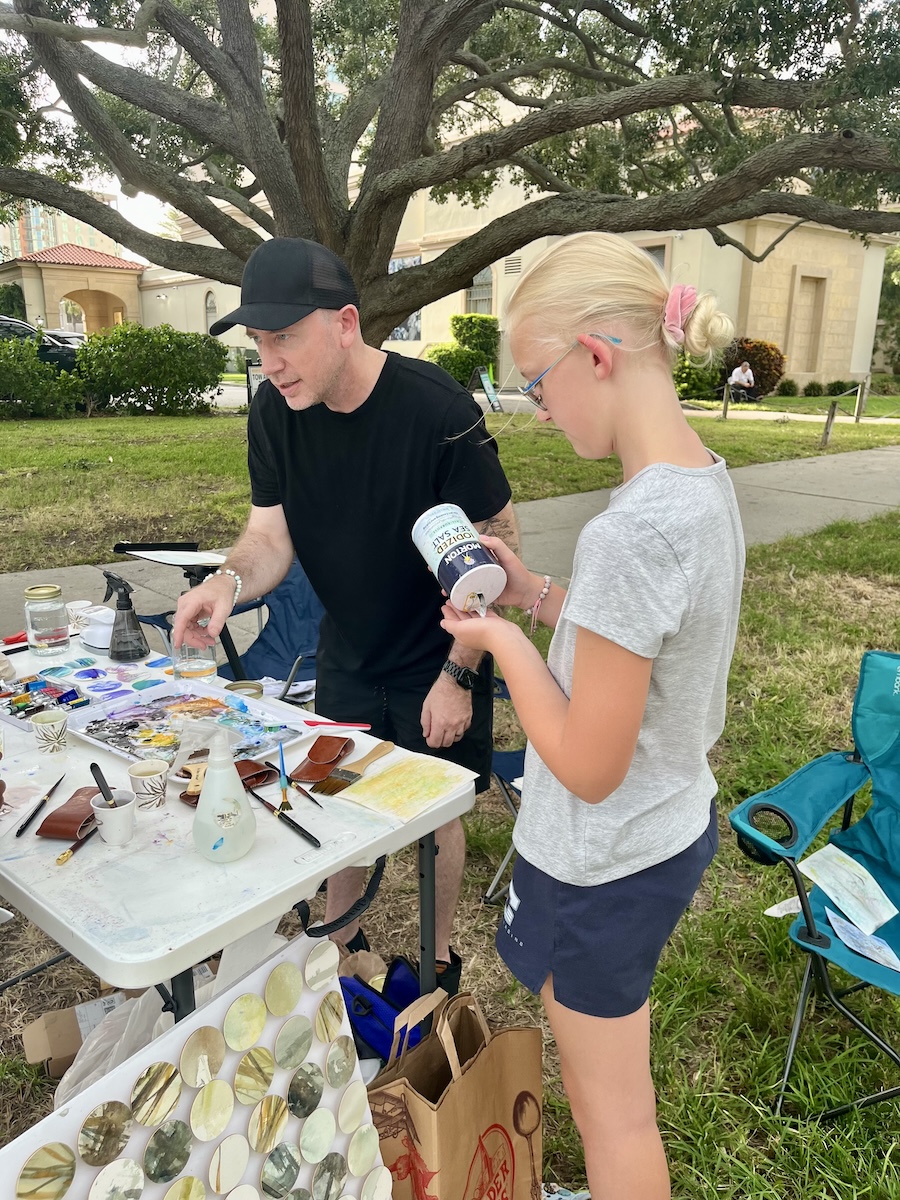 Children were the first to engage with his pop-up painting workshops. Curious by nature, they saw the tent and activity and were immediately interested in participating. But as time went on, more and more people of all ages and socioeconomic backgrounds joined. Seals provided some technical guidance for watercolor painting, but mostly he got to simply talk with and observe the painters. The parallels between the unique characteristics of intermixing salt and fresh water and interacting with different groups of people were not lost on him.
“I learned a lot about myself in the process and a lot about others with this project,” Seals reflected. “I made up a flyer and a sign, but I had some doubts whether anyone would join me. It’s vulnerable and it’s risky to be out in the world — both of which can be said not just of creating art, but of community in any situation. By the end of hosting the workshops I found that being in the community was addicting; I loved the relationships that began through art. There was something analog in the process that was meaningful.”
Not everyone was willing to surrender their completed paintings to be part of the show, but anyone who did contribute was invited to the opening reception at Kress Contemporary. Almost half of the participants came to see the completed diptych alongside Seals’ other watercolor paintings.
“Just a few days before that, we were strangers, but at the art reception, I was able to welcome them by name as new friends,” Seals said. “It was so rewarding to witness how pleased they were to see their piece in an art show. I had painted with some folks who are homeless, with small children, the elderly, and people visiting the US from war-torn countries. Art gave us something meaningful to do together.” 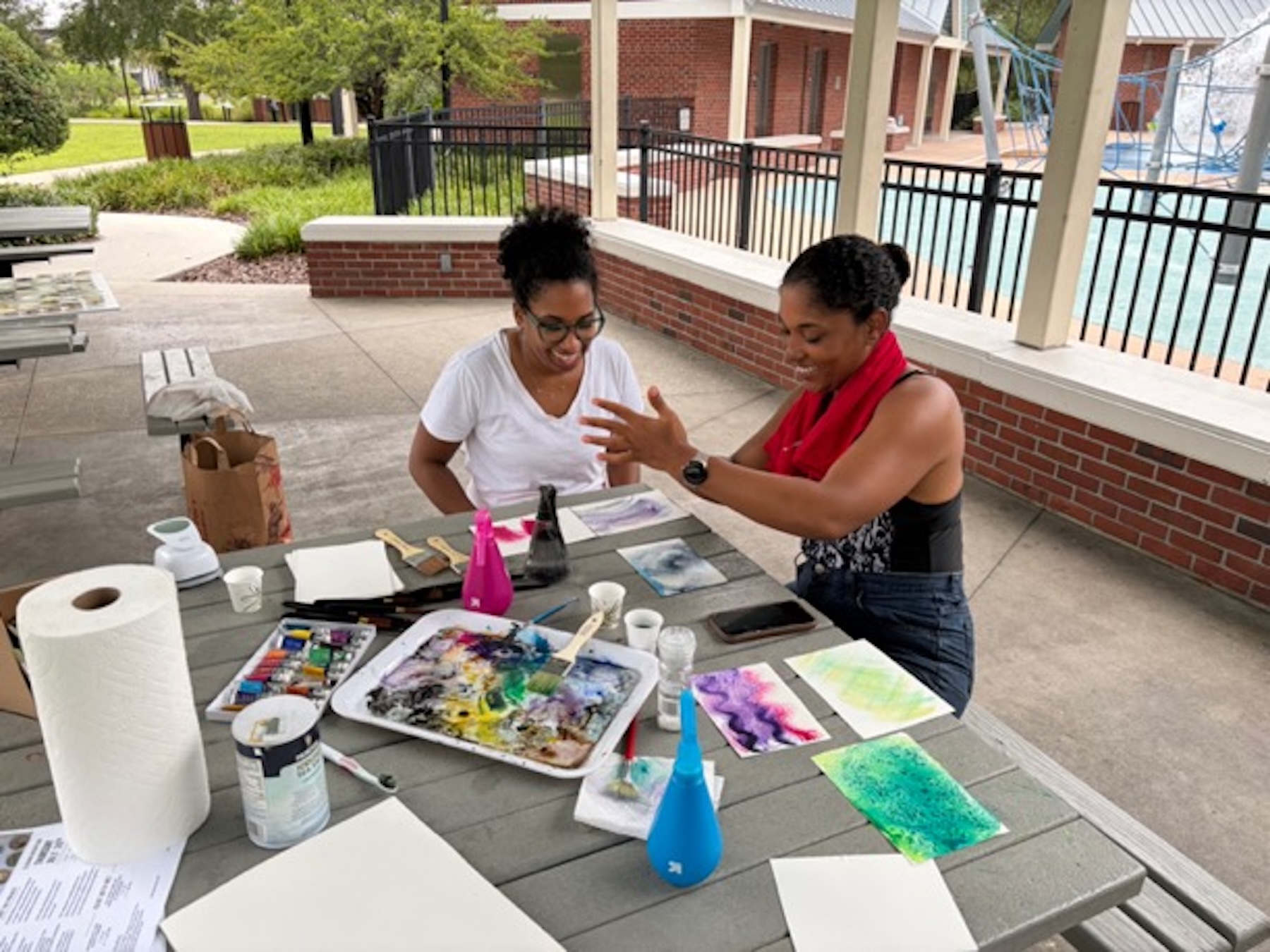
Seals and his family are from the Tampa Bay area, so he is well aware of some of the prevalent issues facing the region including housing insecurity and frequent toxic water conditions. Though the subject matter of his artworks does not tend to overtly address these issues, he is aware that by displaying his paintings publicly and giving talks about his process, he can bring attention to issues that have been laid on his heart.
“We, of course, don’t want to contribute to the problems in the areas we live and visit, but to help solve them,” he said. “I want to hand over a world in which my children can flourish. To that end, I believe that people of faith really need to think about what we’ve been called to care for: both our neighbor and this place. God made us to be gardeners — that communicates a lot about what God cares about. We have a call to care for our environment, to be good stewards of our world and our relationships. We are cultivators; growers of culture.” 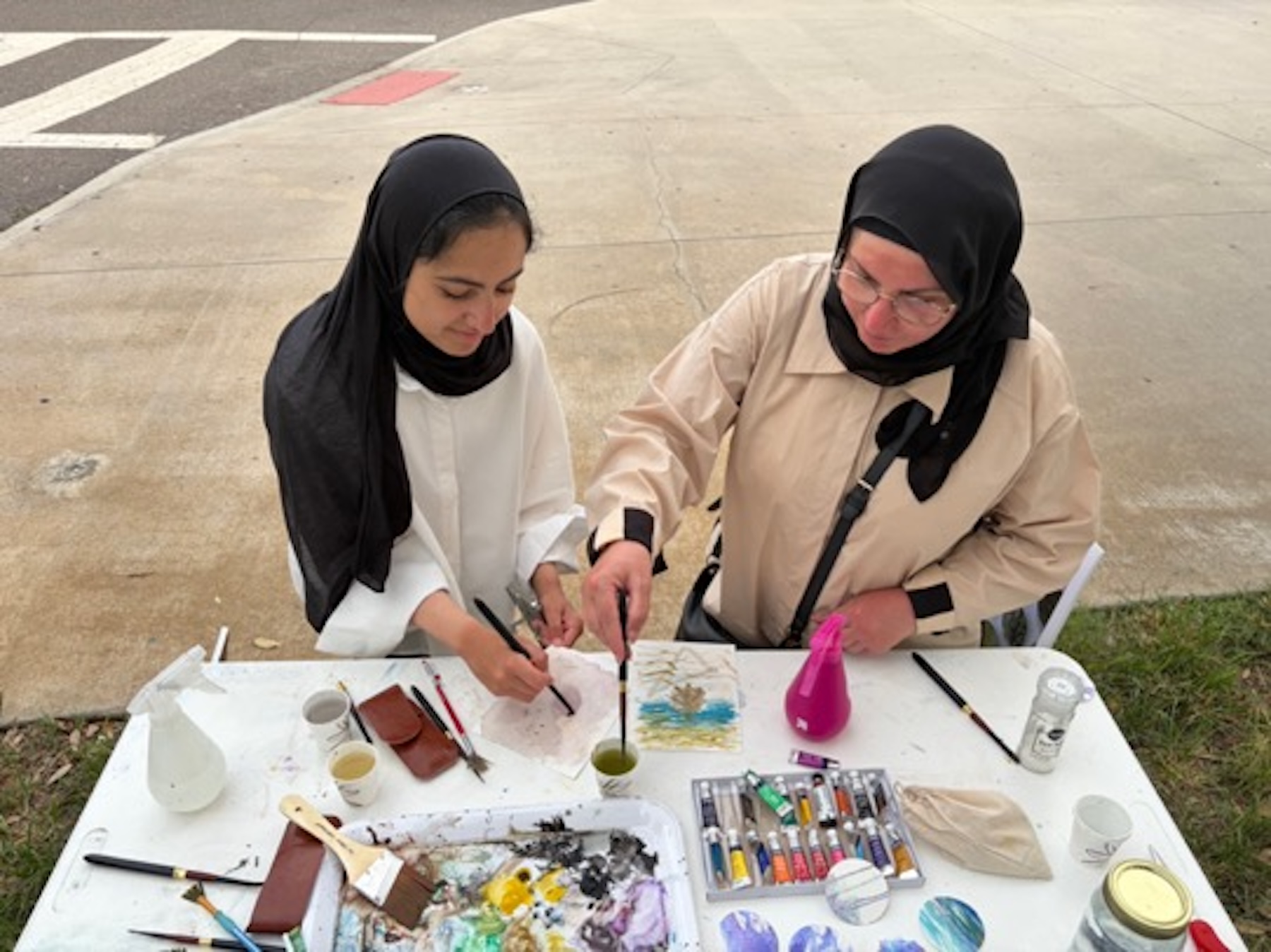
By all accounts, the residency experience was a success. In addition to the initial agreement to host his work and an art talk reception, Kress Contemporary offered to extend the show an additional month and invited Seals back for another talk. The intersection between creativity and collaboration was clearly captivating for the community, the gallery and Seals.
For anyone interested in art residency programs, Seals encourages that connecting your own creative ideas with work already happening in a particular location is a key to not just producing good art, but having a meaningful experience along the way.
“When applying to or participating in a residency, you definitely need to get a feel for the existing community. Understand the conversations currently happening there; work alongside local artists — you’re a guest in their space. Find people doing things you like and want to contribute to and don’t be afraid to get into those situations where people are doing something different; you’re going to be stretched in great ways.”
For more information about the Department of Art and Digital Media, visit Olivet.edu/academics.