
Since 1990, the Los Angeles Film Studies Center (LAFSC), a faith-based independent higher education program, has welcomed undergraduate college students from across the US to sunny Los Angeles for a semester of capstone studies and film industry engagement. Film studies students from Olivet Nazarene University often wrap up their final semester of studies with LAFSC — learning from a wide range of experts who contribute to the film industry.
“The partnership between LAFSC and Olivet has been an invaluable benefit for our students interested in television and film,” says Heather McLaughlin, chair of the Department of Communication. “The program allows students to explore how their faith and art connects as they discern God’s call on their lives.”
Gabe Meinert ’25, who participated in LAFSC in spring 2025, chose to attend Olivet specifically because of LAFSC program.
“My senior year of high school, I was looking for schools that offered film studies and my mom found Olivet. It was a good choice between being in Illinois and having a strong Christian emphasis — plus studying film, I’d basically have to go to LA my senior year. That was a win-win, and from there, I didn’t even look at any other schools.”
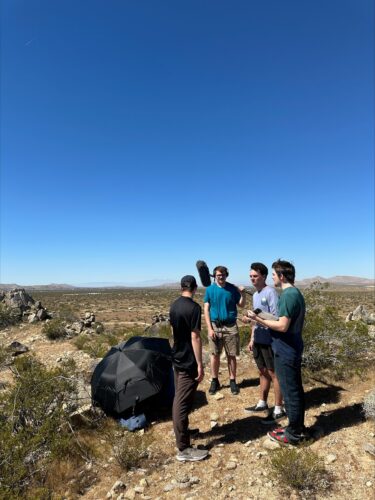
At the very start of his freshman year, Gabe got involved with film and photography on campus. He used his skills as a videographer for the Ollies Follies variety show that annually kicks off the fall semester activities, and quickly found work as a photographer for multiple departments across campus. But his school work in classes in the Department of Communication really helped firm up his technical expertise, which set him up well for his LA experience.
Behind the Scenes
By the time students start the LAFSC program, they will have ideally proven that they have the skills necessary to work in the film industry. Given that many colleges don’t have the budget for industry standard equipment, the semester in LA allows students to actually hone and apply the skills they’ve been learning about. However, Olivet has a strong on-campus film studies program and students credit their required coursework with providing a solid preparation for LAFSC which sets them apart from some of their classmates.
Senior Ava Tueck, a current LAFSC participant, emphasized that her classes at Olivet were foundational in her creative development.
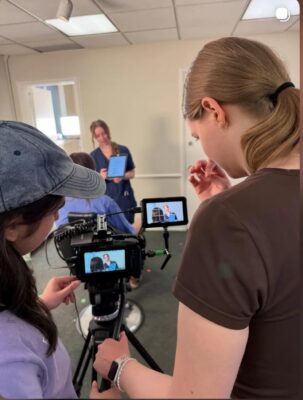
“My COMM classes, specifically those involving working with a team to create a project, have helped my experience in working with others and how production flows,” she reflects. “Having prior knowledge of what shot types and the elements of a film that bring it all together was beneficial when coming to the program. I was able to have the confidence of pitching for director of photography thanks to the experience behind the camera I was able to have.”
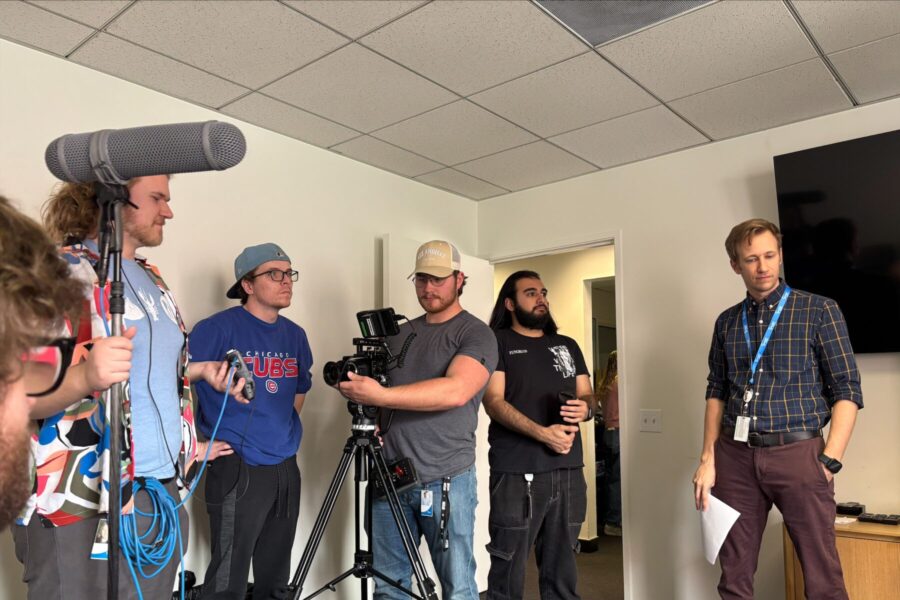
Coursework for LAFSC is primarily project-based with an overarching semester-long assignment to write, produce and edit a short film that is up to par with something that could be submitted to a film festival. Past projects have even won awards at various festivals. For the duration of the semester, students in the program each assume one production role on which they can singularly focus their time and attention.
Senior Eric Lockwood, also currently in the LAFSC program, assumed the role of editor on his team’s short film. He also attributed his confidence in his work to what he had learned at Olivet.
“One class that prepared me for LAFSC was nonlinear editing,” Eric says. “That class made me realize how much I enjoy editing, and now I’m going to be the editor on the short film my team is producing for our Hollywood Production Workshop class. Without learning everything I did from Dr. McLaughlin in nonlinear editing, I wouldn’t have had the confidence to step into that position.”
In addition to collaborating on their short films and fulfilling other course requirements, each student also completes an internship and gets matched with a mentor during the semester.
Gabe cited that the combination of classroom knowledge at Olivet, particularly in a documentary production course; his internship at AbelCine working with industry-standard camera equipment; and his mentorship from an alumnus of the program gave him the confidence he needed to set view his Hollywood dreams as reasonable aspirations.
“My biggest takeaway from LAFSC was that it showed me this is something I can do as a career,” Gabe reflects. “I tend to doubt myself and I wasn’t sure I had the personality or what it takes to make it happen. But, I’ve been encouraged that moving to LA is something I should pursue. Having industry professionals, who clearly know what it takes, tell you that you have it changed my perspective on where I see myself going in my career. I feel that God is calling me back out there.”
In Eric’s internship with Rough Diamond Productions this semester, one of his primary responsibilities is to do coverage — reading scripts that the company receives and providing feedback on whether or not they should be produced into movies. The role has been very exciting for him, given his lifelong interest in filmmaking.
“As someone who likes writing, I really enjoy doing coverage, because it makes me think critically about a script and about why it works or doesn’t work,” he says. “Something else I did once was read a script the company is going to produce and look for any opportunities for product placement. I had a lot of fun doing that, because it made me read a script through a completely different lens than I’m used to, and it was fun to brainstorm companies that might be interested in partnering with Rough Diamond on the film.”
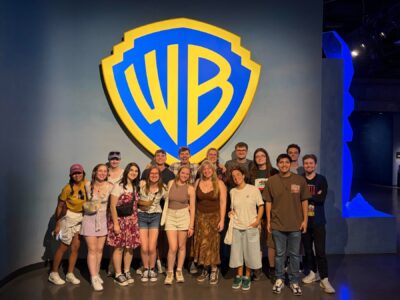
Each spring semester cohort of LAFSC is intentionally small, allowing students to collaborate meaningfully with each other. Courses are taught by working professionals, many of whom are well-connected in the film industry.
“Something that surprised me about the program is how accomplished the professors are in their fields,” Eric says. “Our Narrative Storytelling professor, Jeremy Howe, wrote for The Big Bang Theory and wrote and directed episodes of Young Sheldon. It’s so cool getting to hear his firsthand stories about what it’s like to work on major network shows like those. Our Hollywood Production Workshop professor, Josh Long, has been an assistant director on many productions, so he has great advice on how to run a film shoot efficiently and safely, which will come in handy when we shoot our short films.”
Location, location, location
In addition to the invaluable insights gleaned in classes, internships and formal networking opportunities, Ava, Eric and Gabe all mentioned that one of the major benefits of their semester in LA was simply getting to live in Southern California. Students in the LAFSC program live in a gated apartment complex within walking distance from The Grove, an iconic outdoor movie venue. They can easily go to media events for major award shows and are in close proximity for more casual events like Q/As with professionals at local movie theatres. Plus, ease of access to the beaches, parks and paths that give LA its reputation for an enviable laid-back lifestyle.
“To be honest, LAFSC felt a bit like a three-month vacation, where we got to make art at the same time,” Gabe says of his experience in the program. “We didn’t have many tests or other homework besides projects. Even on days we did a lot of school work, we were busier on things we were passionate about. The people in the program were very collaborative and willing to bounce ideas off each other. That was actually reflective of what I found the industry to be. Ultimately, people want to work together to make some sort of art. We were all there because we shared the same passion for film.”
“Being able to learn from those in the industry about production workflows has been an enlightening experience, just pushing us as students to grow in our craft and work together efficiently on a production set one day,” Ava says of the program. “Other than that, hanging out with the other students from LAFSC is always a blast, whether it’s going to a late-night movie at the Grove or exploring what LA has to offer. Being able to go to the Warner Bros lot and watch a run-through of a sitcom was another highlight as well!”
At the end of the semester, LAFSC hosts a screening event for the premiere of the short films and students’ families and friends are invited, as well as LAFSC program alumni who are still working in LA. Exceptional smaller projects completed during the semester are also highlighted and celebrated by program faculty.
“I encourage those who are considering going to LA to do it,” Ava says. “I had my doubts on coming out here but I wouldn’t regret it — it’s definitely a once in a lifetime experience to be able to do, and Olivet was able to make that happen.”
For more information about the Los Angeles Film Studies Program, visit LAFilmStudies.org. For more information about off-campus academic opportunities that Olivet offers in partnership with other institutions, visit Olivet.edu/Academics/Special-Programs/Campus-Study.