
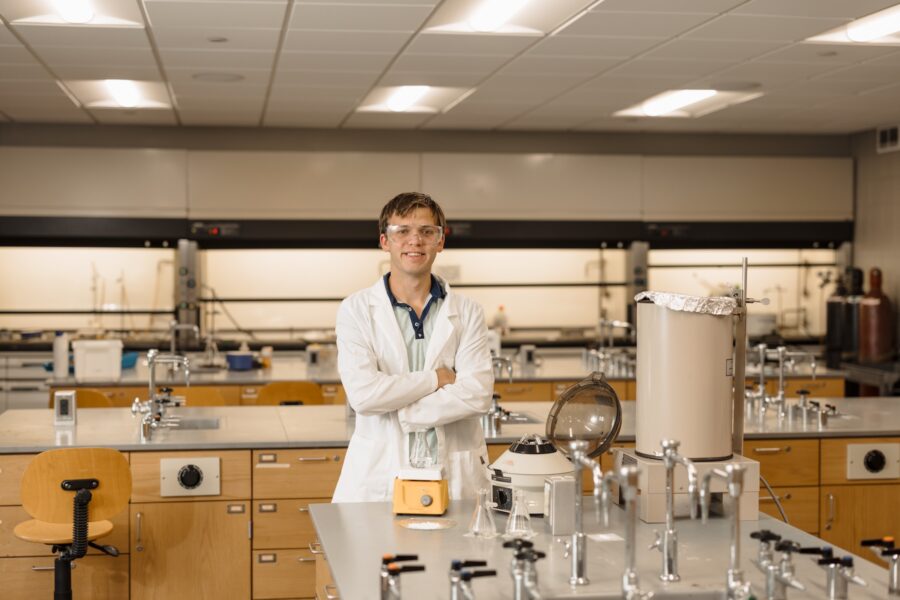
For curious minds, inspiration can truly strike anywhere. Such has been the case for senior Pacey Nack, who is halfway through his capstone University Honors Program research project. In considering topics to explore for this two-year project, Pacey’s love of recreational disc golf prompted an academic investigation of methods that could potentially increase the efficiency of recycling plastics.
“Current recycling methods are relatively ineffective,” Pacey explains. “Each time we recycle something, the plastic quality decreases, leading to it inevitably [ending] up in a landfill. My research focuses on photocatalytic depolymerization, which uses light energy to break polymers down into monomers. These monomers can then be used to make new, high-quality plastic. The process is relatively cheap, and if it can be perfected and scaled, it could lead to a massive reduction in plastic waste.”
Honors students like Pacey spend the first four semesters at Olivet Nazarene University taking four interdisciplinary courses that satisfy general education requirements. Anticipating that they will complete a faculty-mentored research project during their remaining college years, students compile an annotated bibliography during their sophomore year to begin ideation on a research topic of their choice.
It was during this process that Pacey began to consider a research project that might one day impact his leisure activities.
“I knew I wanted to do something chemistry-related,” he says, “but I couldn’t find anything and actually considered dropping out of the program. At the time, I was in Physical Chemistry II with Dr. [Willa] Harper, and the lab portion of that class was to do research on something of our choice. I’m big into disc golf and big into the plastic quality of Frisbees. I was already interested in figuring out which discs last the longest, what they’re made of and if the more expensive ones are actually better quality. So it wasn’t a huge leap to create an honors project about the process of breaking down those materials.” 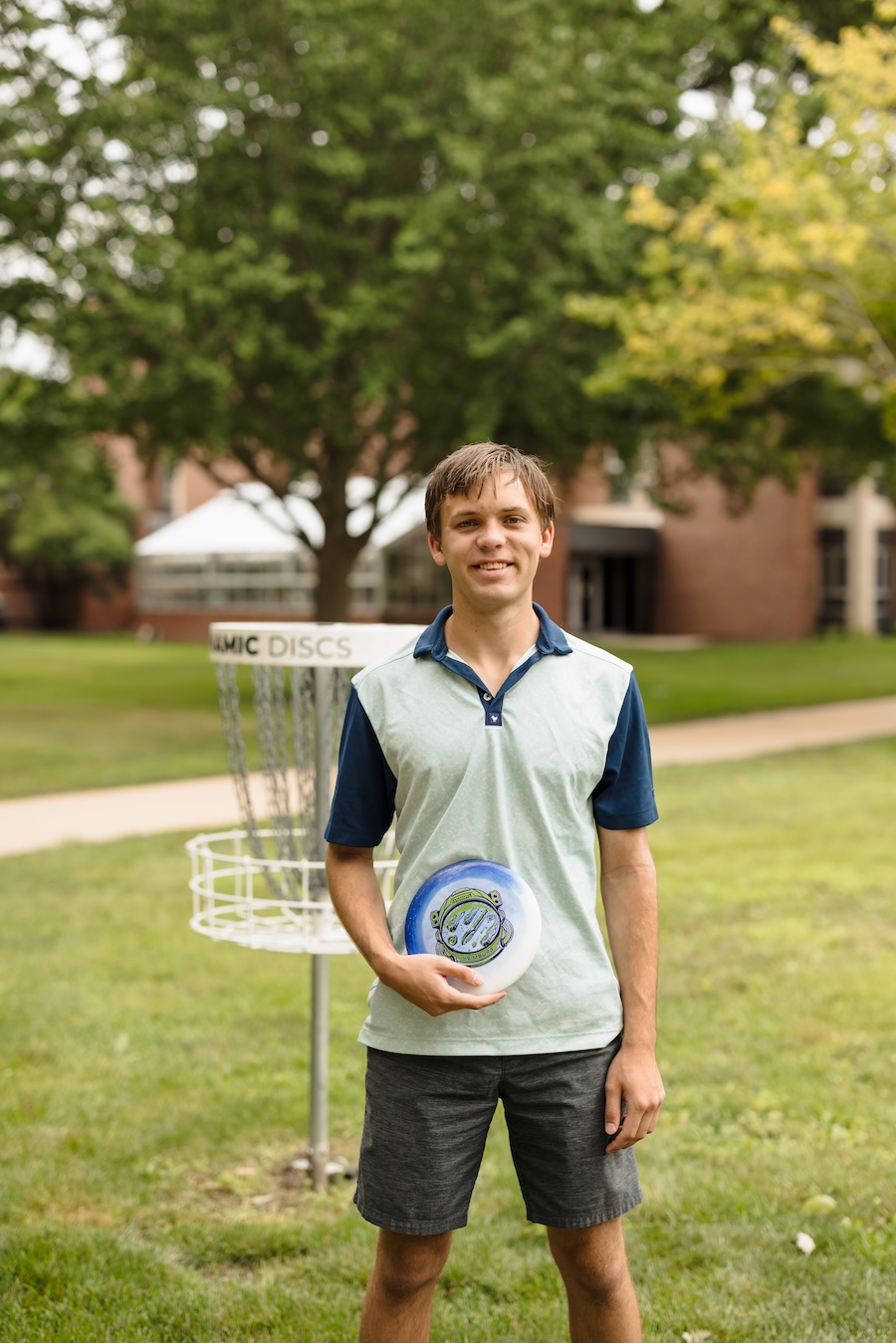
A liberal arts academic environment, like the one offered at Olivet, provides a strong foundation for integrating disparate subject matter like these into a creatively unified idea. In addition to pursuing excellence in his own classes and working as a teaching assistant in various courses in the Walker School of STEM, Pacey competed on the varsity track and field team as a pole vaulter, enrolled in music courses as elective classes, and enjoyed use of the disc golf courses on campus and in the surrounding community. Choosing to enroll in a college that not only emphasizes academic achievement but also helps students develop their faith through community and connection has been a defining element of Pacey’s holistic growth.
“There’s an authenticity that people have at Olivet — from the campus tour guide to professors praying with me,” he says. “I knew I wanted to do something with the gifts and talents I’ve been given. It’s been a blessing studying science combined with a strong faith element. The secular world often separates the two, so it’s been such a blessing to have highly intelligent, highly skilled Christian scientists as role models.”
Bruce Heyen, Ph.D., and Lucas Henderson, Ph.D., have served as mentors on Pacey’s project to help fill in research gaps and clarify potential alterations to his research methods. But the bulk of the work has been his responsibility, and it’s something he has taken very seriously.
“Pacey’s commitment to navigating the complex variables of his experiments has been exceptional,” Drs. Heyen and Henderson said of Pacey in a joint statement. “He isn’t following a lab manual; he is actively troubleshooting and refining a new methodology for plastics recycling for most of this summer. He is committing hundreds of hours to the project and making progress with his research. This kind of hands-on research equips phenomenal students such as Pacey to learn what research is like in top-tier graduate programs while exploring real gaps in research that lay groundwork so future chemists can build upon it in the fight against plastic waste.”
In order to conduct primary research — data collection directly from his own experiments — Pacey spent most days during the summer between his junior and senior years in the lab in Reed Hall of Science. The materials for daily experiments and his time in the lab were covered through funding from both the Honors Program and the Pence-Boyce Research Experience, which annually awards monetary support to Olivet students who are engaged in scientific research.
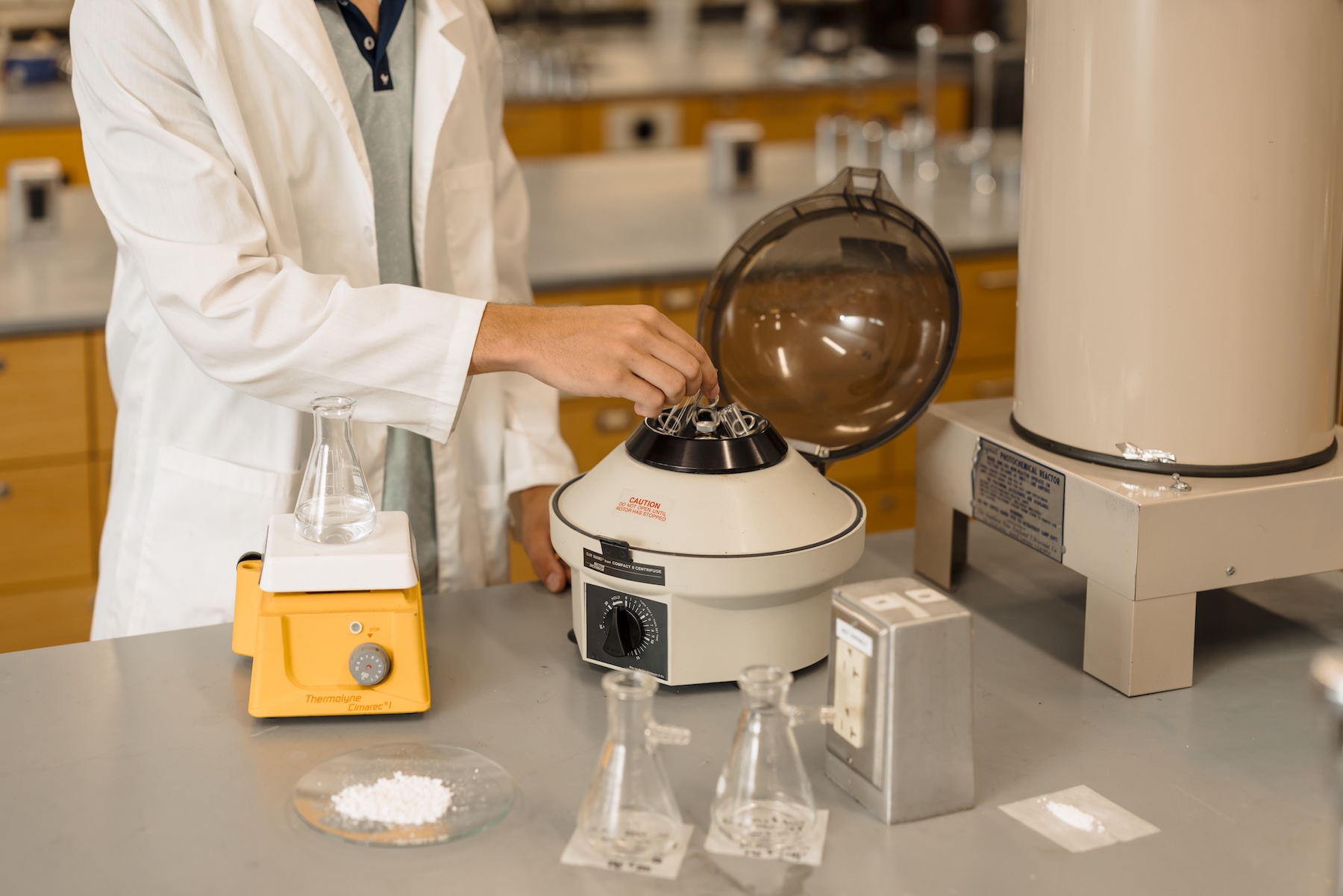 Choosing to embark on the two-year capstone project will likely give Pacey a power grip to shape his shot in graduate school. As he wraps up data collection during his senior fall semester, he also plans to apply for doctoral programs in chemistry. The depth and scope of this type of research demonstrates an expanded academic level of understanding that can be a positive differential for Olivet students who intend to go directly from their undergraduate studies into graduate school.
Even so, the process of moving from theoretical concepts to real-time experimentation has not been without hurdles he has had to overcome. As is the case in most research projects, the initial hypothesis almost never yields the desired result, but Pacey’s optimism for finding a solution remains strong.
“I’ve been learning to be patient throughout the process,” he says of his research. “There are so many variables that go into completing one piece of data. There were multiple times I had to step back and brainstorm ways around obstacles, and in some instances, I had to throw things out and start from scratch. That can be a bit of a letdown. But even if you get negative results, those are still results. I’m building off of someone else’s research, and even if I don’t find a solution, maybe my work will help someone else not have to start at square one.”
To be eligible for application to the Honors Program, students must meet at least one of the following qualifications: have an ACT score of 28 or an equivalent SAT score; graduate in the top 10 percent of their graduating class; or have an unweighted GPA of at least 3.75 on a 4.0 scale.
Read the entire “The Value and Power of an Olivet Education” issue here.