
For nearly 30 years, the Department of English at Olivet Nazarene University has offered an annual trip to the United Kingdom during spring break to any students, faculty and staff who are interested in encountering new cultural experiences. For students, the trip can additionally qualify for college credit.
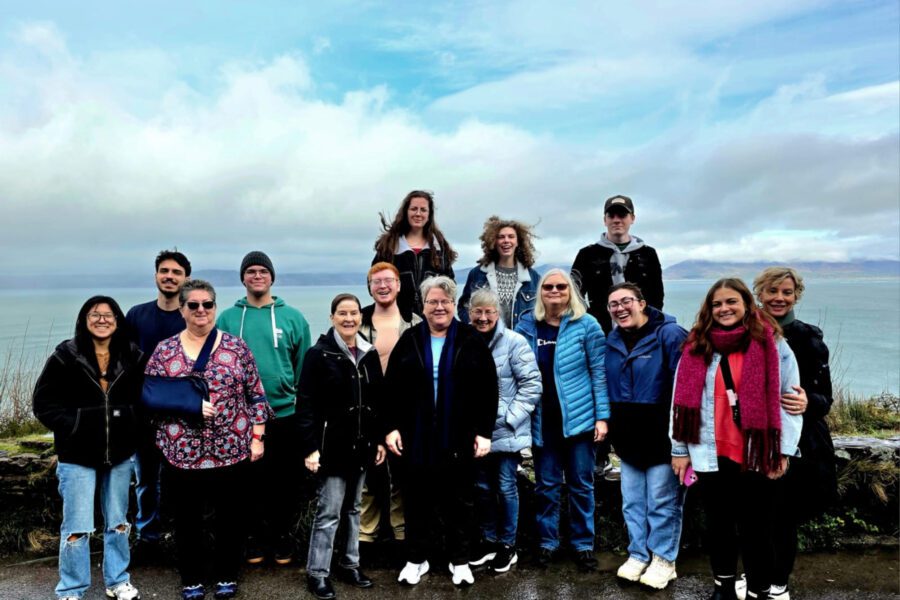
This spring, professors Lynn Dill and Karen Knudson, Ph.D. led a group of 17 students and adults on an excursion to the Republic of Ireland — which though geographically connected to the U.K., is its own sovereign country. Both professors had previously helped to lead the annual spring break cultural trip and were excited to experience Ireland in the company of students, some of whom had not yet traveled out of the U.S., like Jacob Harvey. Others, like Rylie Stroud, had joined one of the previous spring break trips with the Department of English.
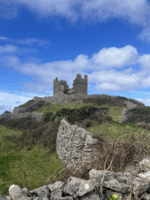
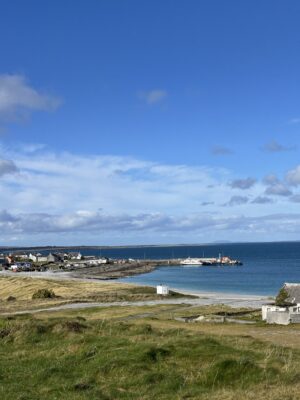
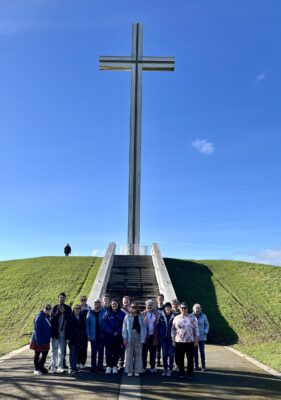
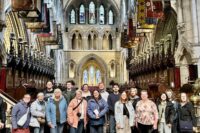
On Thursday, March 5, the group traveled from Chicago O’Hare International Airport to Dublin for six days in Ireland. In addition to visiting iconic Dublin sites like the Temple Bar neighborhood, Ha’Penny Bridge, St. Patrick’s Cathedral and the Long Room at Trinity College, where the Book of Kells is housed, the group also took a tour of the Irish countryside with stops in Galway, Killarney, Cork, Cobh, Inisheer (one of the Aran Islands), and a trip to walk along the Cliffs of Moher.
The group’s collective journey to the Emerald Isle was full of new sights, sounds, tastes and of course, a good deal of craic. Continue reading for highlights and takeaways shared by Lynn, Rylie, Jacob and Karen in the land of a hundred thousand welcomes.
Lynn Dill | professor
“I have always been interested in my family history and a large portion of my ancestors came from the U.K. and the Republic of Ireland. It’s interesting to be able to travel to these places and experience a more concrete connection to places and cultures. In addition, traveling to places like Ireland, Scotland and England offers a powerful extension of literary works I have read and studied, such as reading Dubliners by James Joyce and then being able to walk the streets of Dublin, interact with locals, and imagine the city in the days that he lived.
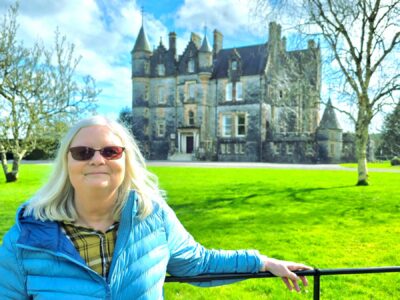
“Study abroad experiences are transformative because they challenge students to step outside of their comfort zones and engage directly with unfamiliar environments. Students develop independence, adaptability and confidence as they navigate new cultures, transportation systems, and social norms. Academically, these experiences deepen learning by making abstract concepts tangible. Literature, history and communication become lived experiences rather than distant ideas. Professionally, students also gain valuable skills — such as cross-cultural communication and problem-solving — that are highly relevant in today’s global workforce.
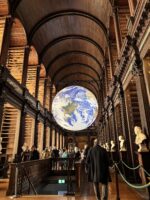
“Perhaps most importantly, travel fosters empathy. Students begin to see the world from perspectives beyond their own, which is essential not only for their academic growth but also for their development as thoughtful, informed individuals. Many students began the experience more hesitant and uncertain and I watched them become more comfortable with both each other and the areas we explored. They learned how to navigate new cities, collaborate with peers in unfamiliar settings, and engage thoughtfully with cultural differences. Reading through some of the travel journals shared by a few students, I was impressed with the amount of detail students noted about the culture and the connections and comparisons to that of the U.S.”
Rylie Stroud | interior and architectural design major
“I was initially interested in this trip because I had a great experience on a previous spring break trip during my freshman year and wanted to take that opportunity again. I was also drawn to the credit option, as it allowed me to complete my intercultural requirement in a more immersive and meaningful way.
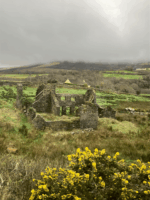
“As someone interested in design, I wanted to see how history, architecture and landscape come together to shape Ireland. The views of the natural landscapes and urban spaces were impactful to just be able to see them with my own eyes instead of through a screen. One thing that stood out to me was that ancient limestone structures or ruins were randomly seen throughout the country. They often stood right next to modern buildings, which made the history feel very present. Being in Ireland made me more aware of how materials, spatial layouts and even lighting are shaped by environmental context. It reinforced the idea that good design tells a story and responds to its surroundings, which is something I want to carry into my future work.
“A favorite place to visit was the Aran Island, Inisheer, and the Cliffs of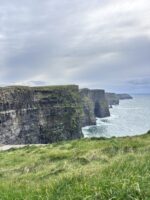 Moher. The weather was clear and sunny with a light breeze, and we had the afternoon to explore the island. A group of us including our guide explored the island together which made the time even more memorable, especially with all the fun and laughter we had. We took a ferry to get an unbelievable view along the cliffs and were even able to see dolphins swimming nearby which made the experience even better. It all felt so surreal. I also enjoyed experiencing Irish culture firsthand. Trying authentic Irish food, hearing live music, and just walking through the streets made everything feel immersive.
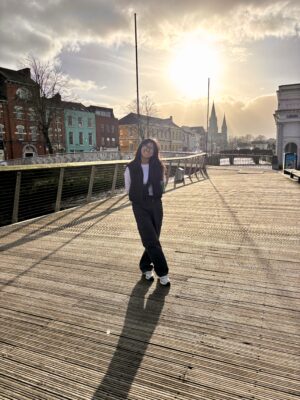
“I think college students should travel abroad and experience other cultures because it widens your perspective. It pushes you out of your routine and cultural box and forces you to see things from different perspectives. It helps you understand how people live differently, what they value, and how environments reflect those values. That kind of perspective is hard to develop in a classroom through textbooks and ultimately make you more aware and creative.”
Jacob Harvey | writing major with a minor in business
“I was initially interested in this trip to Ireland because I had heard about the previous trip two years ago to Scotland, but wasn’t able to go at the time. When I heard this trip was coming up, I wanted to make sure I had the ability to go.
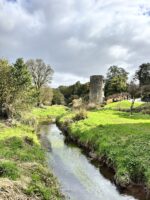
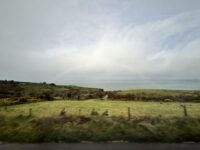
“Ireland has many beautiful landscapes and just about everywhere that we went held some important cultural significance. [One] day we were taken on a ferry to the first of the Aran Islands, Inisheer. It is a small island with a population of around 200 people that was a little slice of authentic Irish rustic life with countless dry-stone walls forming the pastures for the livestock and the remains of the O’Brien castle. On the ferry ride back, we sailed along the coast to get a better view of the Cliffs of Moher.
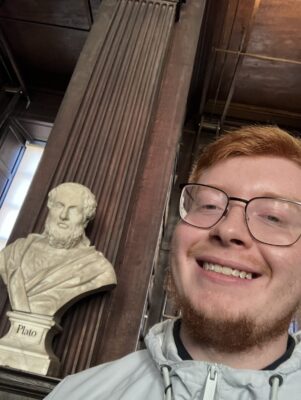
“This trip was very impactful on my educational journey. Everywhere we went, our tour guide explained the generational history that had shaped the land into the country it is today. Ireland keeps the buildings and ruins of centuries long past instead of letting them be destroyed, allowing the historical memory of each place be a memorial for what the people had to suffer through to get to this point. We visited several museums ranging from the emigration due to the Irish Famine to the remembrance of the people who lost their lives on the Titanic, which was constructed in Northern Ireland in Belfast. All of these places put into perspective the impact of our world’s past, the struggles with colonialism, and the legacy of the people who fought to strive for a brighter tomorrow. One author that is brought to mind is the works of W. B. Yeats spearheading the restoration of the language, literature, and folklore of the Irish people which was largely lost due to English Colonial rule.
“When I was first going on this trip, I thought it would be this glamorous tour of seeing the highlights and natural beauty of Ireland. While that was a part of the experience, the grander experience was learning about the people that lived there, what their history was like, and how they were living today. By interacting with both tourists and locals every step of the way I found the trip to be more about the human connection that was made more than the scenic views.”
Karen Knudson | professor
“My field of study is British literature, so I’ve read a lot of literature that comes from this part of the world. I love to be able to place that literature, literally. The authors, poets, and playwrights that I read become real in a new way when I see the places where they grew up or spent their time while writing as adults. The landscape itself helps teach us about their worldview and culture, but the tour guides and local guides also contribute so much to our understanding of historical or contemporary culture.
“I love being able to talk to students who are on the trip about what we’re seeing, experiencing and learning about. They inevitably have a greater appreciation and understanding. Another important aspect for students is the expansion of their understanding of the world. We are all reminded that our own (American) perspective is only one among many, and that, especially, the perspective of Europeans is much longer historically. We can all learn from that perspective if let ourselves.
“I think our students got a glimpse of that. The Irish people are probably the most welcoming of the various folks I’ve interacted with on my various trips. That was so heartening in this time when we aren’t sure of our reception in other parts of the world. In a more basic way, as a Mid-westerner, I enjoy visiting a beautiful island. It’s just so different. I really enjoyed the day we took a ferry from Ireland to the small Aran island of Inishear (Inis Oirr in Irish Gaelic). It was just beautiful.”
For more information about the Department of English at Olivet, visit Olivet.edu/Academics.
Photos Submitted by Lynn Dill, Jacob Harvey and Rylie Stroud