
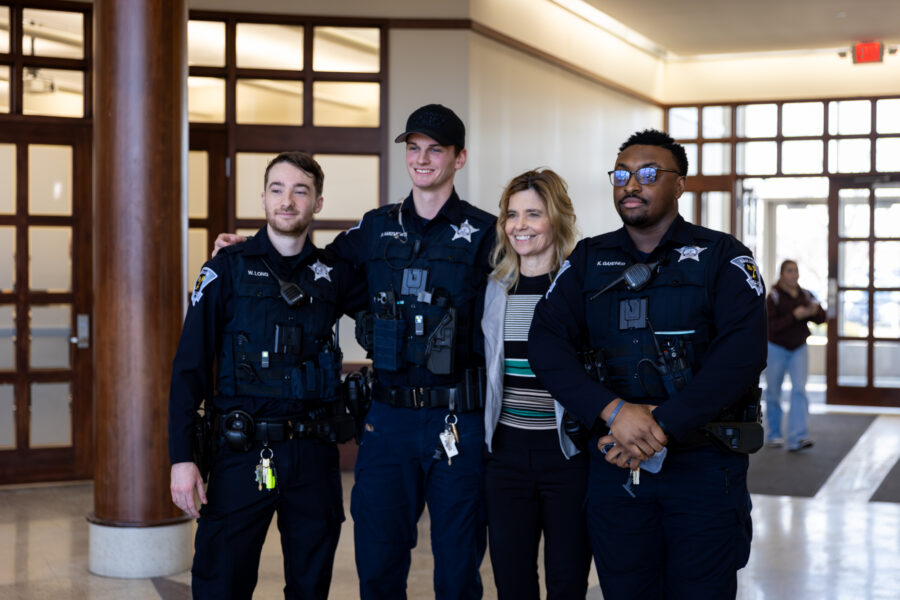
On Tuesday, February 10, visitors to Weber Center on the campus of Olivet Nazarene University, might have been concerned to see multiple City of Kankakee police cars parked outside of the building. However, inside, there was cause for celebration as three patrolmen, who happen to be Olivet alumni, were sharing about their academic and career experiences with current upper class students in a criminal justice seminar.
Shelly Stroud, Ph.D., professor in Olivet’s Department of Social Work and Criminal Justice, frequently invites members of local law enforcement agencies to share about their work in the weekly seminar class in order to give students an inside look into potential career options. The unique perspectives that are given and the networking opportunities of connecting students with internship and job possibilities adds a richness to the theoretical curriculum covered in coursework. It is extra special when the guest speakers are also alumni of the program.
“Inviting criminal justice alumni to speak is valuable because it connects classroom learning to real-world application,” Dr. Stroud explains. “Our alumni demonstrate how professional skills, and Christian values such as integrity, justice and compassion are lived out in practice. Their involvement strengthens our program by enhancing student engagement, promoting career readiness, and demonstrating commitment to integrity and service. By sharing their career journeys and professional experiences, students are exposed to the diverse field of criminal justice and helps prepare them for the realities they may face.”
Do Justly, Love Mercy
During the hour-long seminar, Officers Ben Mathews ’24, Kahari Gardner and Wade Long ’25 were invited to talk openly about how the preparation they received in classes at Olivet, in combination with the intense but impactful Illinois Police Academy experiences, have helped them each embrace their roles within a local police force. After brief introductions, the floor was opened for questions from the audience, which included a mix of criminal justice and social work students and faculty.
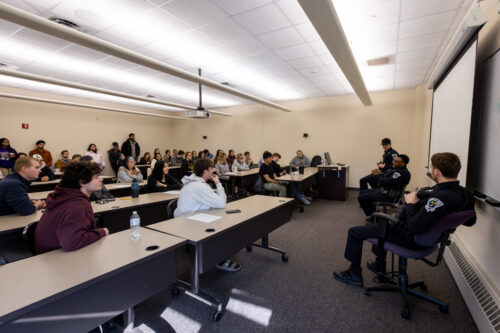
In response to questions regarding the demands of their work, the men were honest.
“When you watch the news, you can hear about how broken the world is. But dealing with so much brokenness on the job, it’s sad to see and really eye opening,” Ben commented. “I don’t know what it’s like to be homeless and hungry. I just try to meet people where they’re at and get on their level.”
All three officers agreed that their work is more about serving their community, than exerting control over people.
“If you have a problem with authority, this is not the job for you,” Kahari cautioned. “You get a lot of power, but you have a lot of responsibility and you have to balance that power with being humane. You are a problem solver on the job, but there are days I don’t have a solution. You have to figure out how to figure things out.”
“When we deal with the same people over and over, it can feel hopeless,” Wade commented. “But at the end of the day, we’re not going to change the way we deal with the call for service. Everyone seems like they have a chance to make it out of a bad situation. It’s our job to serve and help.”
Walk Humbly
Speaking to a room full of students, many of whom are interested in careers in criminal justice, the officers discussed their journeys through the Illinois Police Academy and the testing/application process to actually become an officer.
Wade said, “It was a bit overwhelming to go from crossing the graduation stage straight to the Academy. The four months of training there felt like being back in school. But, the Academy was a refresher course because it was all stuff we heard in the classroom [at Olivet].”
Even after earning a bachelor’s degree in criminal justice and completing the academy training, Wade humbly recognized that the career of a police officer would be one of continuing education.
“When I came out of the Academy, it felt like I was restarting — like we were tossed into the fire,” he said. “You can’t prepare enough to know how to solve every possible situation. I’m still learning every day.”
A prevailing theme of the seminar was how to stay grounded in a career in which the officers daily confront devastating brokenness.
“You’re going to see things that aren’t natural,” Kahari commented. “You have to try not to bring work home. Address what happened — don’t keep it in.”
“It’s so great having these guys, these men of God,” Ben said, referencing Kahari and Wade. “I also try to stay grounded in my faith community at church and my family. I think it’s also important not to lose sight of hobbies — for me it’s fishing, working out, burning off some steam after a hard shift.”
There was consensus that beyond just a strong academic foundation, the criminal justice program at Olivet had provided a strong faith foundation for their work.
“You’re in a good spot — I love this criminal justice program,” Ben encouraged. “There aren’t a lot of college classes that will teach criminal justice info with faith-based curriculum; [let alone] that the faculty offer up a devotion and pray before talking about stuff that’s hard to talk about. The professors at Olivet support you not just as students, but in your future career.”
For more information about the Department of Social Work & Criminal Justice or any of Olivet’s 200+ areas of study, visit Olivet.edu/Academics.
In addition to offering an undergraduate degree in criminal justice, Olivet offers MBA and MOL degrees with criminal justice tracks, for industry professionals who want to expand their knowledge. For more information, visit Olivet.edu/Academics/Graduate-Programs