
“Vegetables feed the body, but flowers feed the soul.” – Janie Case Beuthin

Not everyone grows up knowing what they’d like to do for a career. That can be particularly true during the young adult years when society places a certain pressure on people to choose a major and seemingly commit to a lifetime of one type of job. In reality, many people’s career journeys look more like winding garden paths than straight, paved roads.
That has certainly been true for urban flower farmer Janie Case Beuthin ’06.
Although she had an inkling at a young age that she would eventually work with her hands, by the time Janie enrolled at Olivet Nazarene University, she was very unsure of what to actually study. In fact, Janie didn’t decide on a major until well into her sophomore year. After taking a range of courses that piqued her interest, she decided to major in family and consumer sciences, and eventually added a minor in English. The shift prompted her to study abroad in the Oxford studies program during the fall semester of her senior year. The temporary transplanting gave her a fresh perspective on what it means to bloom where you’re planted.
“It was phenomenal to live in England and study there,” Janie reflects. “It deepened my educational experience so much to get outside of my comfort zone. Plus, I met lifelong friends — my roommate from Oxford is actually now also doing flower farming in Canada!”
After graduating from Olivet, Janie got engaged to Ryan Beuthin ’05. Following a year of long-distance dating, followed by getting married and living in Texas for a year, they moved to Virginia for his master’s studies at the Center for Justice and Peacebuilding at Eastern Mennonite University. Ryan studied conflict resolution and community-building alongside classmates who came from war torn countries and conflict zones. Many had enrolled in the program to gain knowledge and practical tools to go back and hopefully implement positive change in their home communities after graduation.
At the completion of Ryan’s studies, the Beuthins moved back to Eastern Michigan to plant roots in the Flint area. Janie had grown up in the area and was excited to establish new ties with her own young family.
“I love the city,” she says of Flint. “It’s just a super quirky, unpretentious place; tenaciously overcoming a difficult history.”
Though hardly a conflict zone, Flint is known for its high poverty and crime rates in addition to infrastructure issues. When Janie and Ryan decided to buy a home in the city, they committed to fully integrating their lives in the community. They didn’t anticipate they would solve deep-seated issues with goodwill. But, inspired by Ryan’s classmates desire to intentionally pour into their communities, the Beuthins approached the opportunity by asking “How can we positively contribute to change in Flint?”
“We were committed to moving home without jobs, without a plan, but open to what God might want us to do,” Janie says.
Planting Roots
The Beuthins bought an old home in a quiet 1920s historic neighborhood, quickly realizing that the solitude was due to five empty houses on their block. Families eventually moved into many of the homes, but the house on the adjacent lot was in such bad shape that the city took it down. The blank canvas sparked a creative idea for Janie and Ryan.
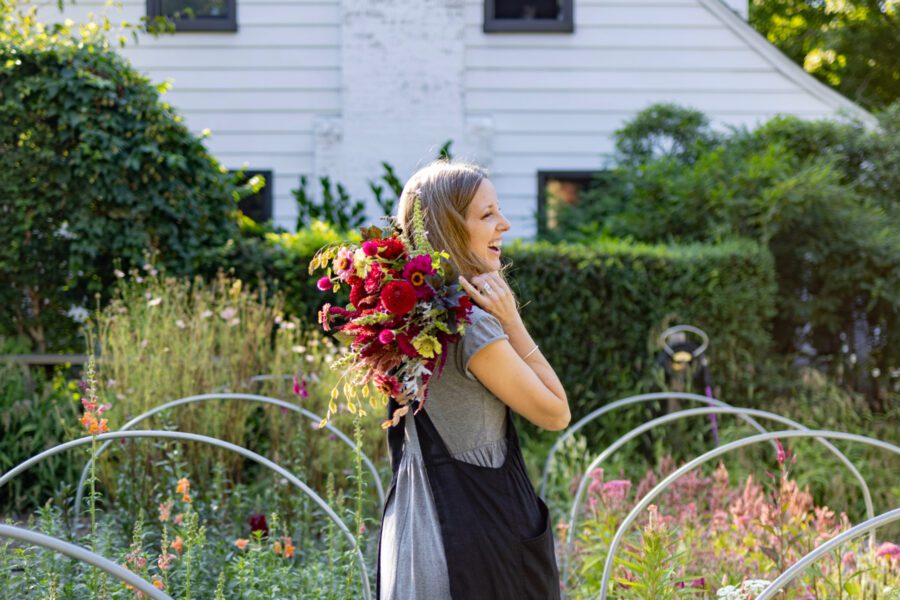
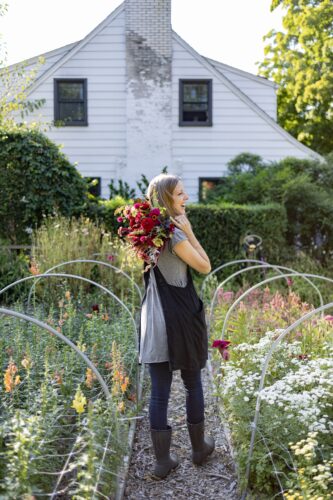
Ryan had taken some permaculture classes and both he and Janie were interested in sustainability projects they could implement in a city environment. Initially, they adopted the vacant lot and planted a large vegetable garden with a little space dedicated to cut flowers. But after years of harvesting weeds, Janie took over the garden with flower beds. As her garden and dreams grew, she and Ryan bought the lot and in 2018, Twig End Farm was formally established.
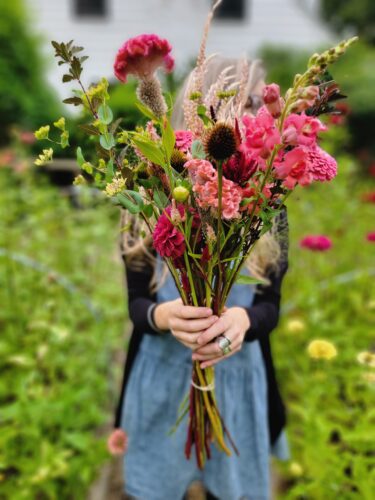
“There are so many ways people work with flowers and get them into the community — flowers can bring so much joy to so many people,” Janie says of her passion for farming. “Flowers provide aesthetic beauty and fragrance, but they’re impermanent, fleeting and special. Every bloom is so different; flowers all have personalities and each one needs to be harvested differently.”
On her boutique urban farm, Janie grows seasonal specialty cut flowers for special orders, events, arranging workshops and as of spring 2026, weekly vending at the Flint Farmer’s Market. As she was getting started with Twig End Farm, she supplemented her amateur knowledge with some small-scale gardening courses as well as marketing and photography workshops. In 2019, she won a scholarship through Floret Flowers, a premier flower farm and seed company, which further expanded her skills.
Given that the garden is landlocked within the neighborhood, as demand for Twig End Farm has grown, Janie has had to be very creative with her planning and use of space. She doesn’t have a big hoop house that would extend the harvest season, so she’s been very strategic about when to “flip” certain beds and how to efficiently maximize space for flowers that don’t have to be harvested daily. In doing so, she’s found joy in nurturing each flower variety and cultivar.
Plus, while working from home has occasionally had its downsides, Janie loves the opportunity to cultivate beauty in her own backyard.
“In the spring when plants are going in and in the fall when things are shutting down, I have big weeks of intense labor. But day-to-day, I try to get outdoor things done as early as possible. I typically come in by lunch and work on orders in the house studio. I try to have everything done by 2 p.m. to rest and recharge before doing school pick-up and then have the rest of the evening available to my family.”
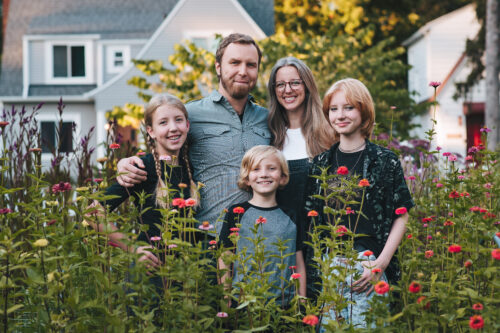
“I wanted Twig End to be something that grew as the children grew,” Janie says of her vision for the company. “The business kept me home, but with my hands in the dirt. I’ve found that being creative and putting beauty in the world has been a big connecting point [in our community].”
In addition to offering the fresh cut flowers for subscriptions, events and personal orders, she has dedicated a significant amount of space in their garage loft for drying flowers to use during off-season workshops like creating wreaths out of dried florals. Every time she interacts with clients and workshop attendees, she has witnessed a new facet of community flourishing as strangers become neighbors over a common interest in flowers.
An Abundant Harvest
Over the years, Janie’s reach from her boutique urban garden has evolved. This past winter, she was invited to present at the Michigan Organic Food and Farm Alliance annual conference, held at Michigan State University (MSU), where she shared about how Twig End Farm operates small-scale flower farming. She had previously hosted groups from MSU for educational purposes, in addition to hosting local workshops in her garden to share the wealth of her lived experiences with others who want to similarly use their spaces to grow plants in their community.
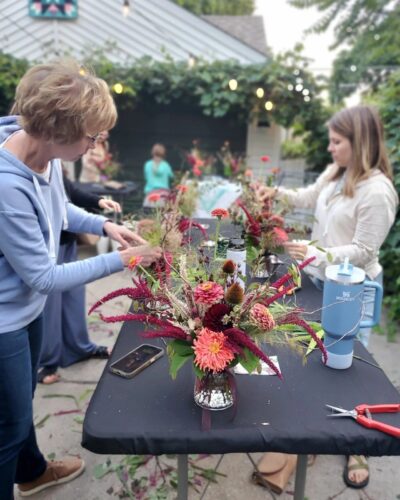
Janie has loved these opportunities to challenge herself professionally, but the most fruitful aspect of her work has been witnessing her own faith in bloom.
“I feel closest to God in nature — working under the open sky, learning how seeds function — I feel so, so blessed.” Janie reflects. “God opens the doors. He knows the desires of our hearts, even when we don’t know how to articulate those desires.”
Her career path has not been straightforward, but Janie has enjoyed how the small seeds of gardening ideas and business goals have created a vibrant landscape — both literally in her backyard and figuratively in her hometown.
Janie adds, “I hope I’m being a light in the community by being here and being committed to Flint for the long haul. There are ups and downs and ins and outs, but we want to be a part of it all.”
All photos submitted by Janie. Photography credits: Freshwater Image & K. Laine Photography
For more information about Twig End Farm, visit https://twigendfarm.com. For more information about the 200+ areas of study offered by Olivet, visit Olivet.edu/Academics.